I hope you like the pics and gifs that I've chosen for you. The butterfly that I have chosen is the Red Admiral (Vanessa atalanta). This is my first butterfly swap and this butterfly looked very interesting.
Family: Nymphalidae
Subfamily: Nymphalinae
Identification: Upperside is black with white spots near the apex; forewing with red median band, hindwing with red marginal band. The winter form is smaller and duller, summer form larger and brighter with an interrupted forewing band.
Wing Span: 1 3/4 - 3 inches (4.5 - 7.6 cm).
Life History: The Red Admiral has a very erratic, rapid flight. Males perch, on ridgetops if available, in the afternoon to wait for females, who lay eggs singly on the tops of host plant leaves. Young caterpillars eat and live within a shelter of folded leaves; older caterpillars make a nest of leaves tied together with silk. Adults hibernate.
Flight: Two broods from March-October in the north, winters from October-March in South Texas.
Caterpillar Hosts: Plants of the nettle family (Urticaceae) including stinging nettle (Urtica dioica), tall wild nettle (U. gracilis), wood nettle (Laportea canadensis), false nettle (Boehmeria cylindrica), pellitory (Parietoria pennsylvanica), mamaki (Pipturus albidus), and possibly hops (Humulus).
Adult Food: Red Admirals prefer sap flows on trees, fermenting fruit, and bird droppings; visiting flowers only when these are not available. Then they will nectar at common milkweed, red clover, aster, and alfalfa, among others.
Habitat: Moist woods, yards, parks, marshes, seeps, moist fields. During migrations, the Red Admiral is found in almost any habitat from tundra to subtropics.
Range: Guatemala north through Mexico and the United States to northern Canada; Hawaii, some Caribbean Islands, New Zealand, Europe, Northern Africa, Asia. Cannot survive coldest winters; most of North America must be recolonized each spring by southern migrants.
An owl butterfly is a butterfly, in the genus Caligo, known for their huge eyespots, which resemble owls' eyes. They are found in the rainforests and secondary forests of Mexico, Central, and South America
With all the beautiful butterflies everyone is sharing I thought I would find one a little less showy ..... or is it?
The Dead Leaf butterfly, Kallima inachus, is an incredible camouflage expert. Once in place, the butterfly closely resembles a dry leaf with dark veins and even a stalk.
The Dead Leaf butterfly can be found in India, Nepal, Bhutan, Bangladesh and Myanmar. While in Southeast Asia it occurs in southern China, Thailand, Laos, Taiwan and Vietnam.
With its wings open the Dead Leaf butterfly's colors rival that of any of the species.
There are other "Leaf" butterflies but I found this one fascinating because of the pronounced contrast in the top and bottom of its wings. I hope you do too.
BL~ Butterfly profile deco ლ August
I hope you are enjoying these swaps as much as I am! THANK YOU for joining in! ;-)
I am going to focus on the Arhopala Hercules Butterfly...because it is my favorite color! ;-)
It is also known as the The Purple-glazed Oakblue (Arhopala agaba, sometimes placed in Amblypodia[1])
IT is a small butterfly found from India to Thailand, Langkawi, Indo China, Peninsular Malaya to the Philippines and Sumatra that belongs to the Lycaenids or Blues family.
It has a very beautiful Purple Shimmer
Enjoy your swap & Blessings, cc



Page 45 of Krochet4Life's Comments
Back to Krochet4Life's profile
BL~ Butterfly profile deco ლ August
I hope you like the pics and gifs that I've chosen for you. The butterfly that I have chosen is the Red Admiral (Vanessa atalanta). This is my first butterfly swap and this butterfly looked very interesting.
Family: Nymphalidae
Subfamily: Nymphalinae
Identification: Upperside is black with white spots near the apex; forewing with red median band, hindwing with red marginal band. The winter form is smaller and duller, summer form larger and brighter with an interrupted forewing band.
Wing Span: 1 3/4 - 3 inches (4.5 - 7.6 cm).
Life History: The Red Admiral has a very erratic, rapid flight. Males perch, on ridgetops if available, in the afternoon to wait for females, who lay eggs singly on the tops of host plant leaves. Young caterpillars eat and live within a shelter of folded leaves; older caterpillars make a nest of leaves tied together with silk. Adults hibernate.
Flight: Two broods from March-October in the north, winters from October-March in South Texas.
Caterpillar Hosts: Plants of the nettle family (Urticaceae) including stinging nettle (Urtica dioica), tall wild nettle (U. gracilis), wood nettle (Laportea canadensis), false nettle (Boehmeria cylindrica), pellitory (Parietoria pennsylvanica), mamaki (Pipturus albidus), and possibly hops (Humulus).
Adult Food: Red Admirals prefer sap flows on trees, fermenting fruit, and bird droppings; visiting flowers only when these are not available. Then they will nectar at common milkweed, red clover, aster, and alfalfa, among others.
Habitat: Moist woods, yards, parks, marshes, seeps, moist fields. During migrations, the Red Admiral is found in almost any habitat from tundra to subtropics.
Range: Guatemala north through Mexico and the United States to northern Canada; Hawaii, some Caribbean Islands, New Zealand, Europe, Northern Africa, Asia. Cannot survive coldest winters; most of North America must be recolonized each spring by southern migrants.
Blessings,
Yvonne
I hope your summer is going well! Mine has too much work and not enough swimming for my liking! Happy Swapping!
-Making It Right August Profile Deco
Making It Right-August Profile Deco
BL~ Butterfly profile deco ლ August
By Sugardragon
:0) Happy swappin :0)
Speyeria zerene, the zerene fritillary, is a species of butterfly found in the western portions of the United States and Canada
BL~ Butterfly profile deco ლ August
Hope you like!! Enjoy! MichelleGG
An owl butterfly is a butterfly, in the genus Caligo, known for their huge eyespots, which resemble owls' eyes. They are found in the rainforests and secondary forests of Mexico, Central, and South America
BL~ Butterfly profile deco ლ August
With all the beautiful butterflies everyone is sharing I thought I would find one a little less showy ..... or is it?
The Dead Leaf butterfly, Kallima inachus, is an incredible camouflage expert. Once in place, the butterfly closely resembles a dry leaf with dark veins and even a stalk.
The Dead Leaf butterfly can be found in India, Nepal, Bhutan, Bangladesh and Myanmar. While in Southeast Asia it occurs in southern China, Thailand, Laos, Taiwan and Vietnam.
With its wings open the Dead Leaf butterfly's colors rival that of any of the species.
There are other "Leaf" butterflies but I found this one fascinating because of the pronounced contrast in the top and bottom of its wings. I hope you do too.
(I love these swaps)
BL~ Butterfly profile deco ლ August


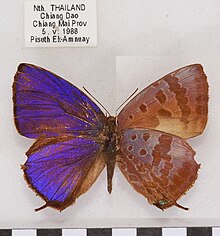
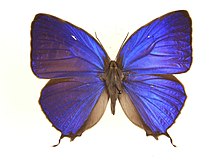


I hope you are enjoying these swaps as much as I am! THANK YOU for joining in! ;-) I am going to focus on the Arhopala Hercules Butterfly...because it is my favorite color! ;-)
It is also known as the The Purple-glazed Oakblue (Arhopala agaba, sometimes placed in Amblypodia[1])
IT is a small butterfly found from India to Thailand, Langkawi, Indo China, Peninsular Malaya to the Philippines and Sumatra that belongs to the Lycaenids or Blues family.
It has a very beautiful Purple Shimmer
Enjoy your swap & Blessings, cc
hi, how are you? hope your weather is more summer then mine. we are getting rain daily.
Knock, knock! I'm just stopping by to invite you to take a look at our Christian Swappers Group forums, we have an AUG: $5 Esty Gift Card 🙠Bible Trivia Game going on in the group forum now.
Come join in on the fun! Win a $5.00 Esty Gift Card - Enter by 8/31/2016
God bless you! ~Rachael